
Project website: www.percevite.org
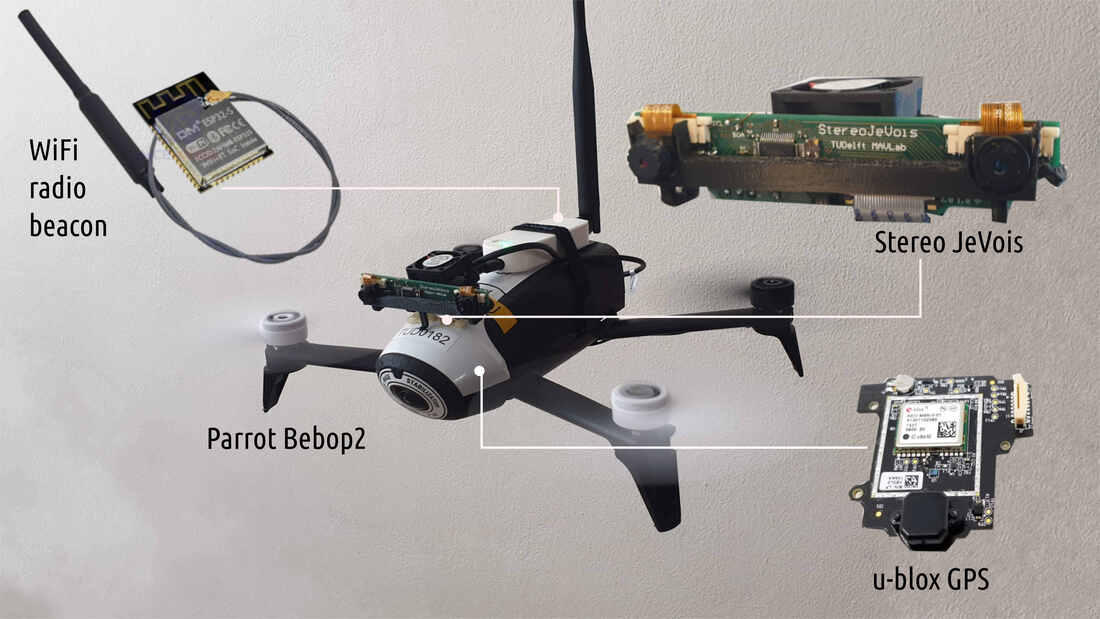
PercEvite (2017–2020, from the French “percevoir et éviter”, perceive and avoid) developed a sensor, communication and processing suite for small drones. It lets them detect and avoid obstacles on the ground and stay well clear of other air vehicles without human intervention. The project was coordinated by the MAVLab of TU Delft and funded by SESAR.

Goals
- Static obstacle detection: a safe system with state-of-the-art hardware and algorithms for static obstacle detection.
- Collaborative collision avoidance: communication hardware and software for collaborative collision avoidance, and for extracting more visual information than stereo vision alone.
- Non-collaborative avoidance: sensors for non-collaborative collision avoidance.
- Size, weight and live demonstrations: achieve all goals while reducing size and weight, and show this in live demonstrations.
Why
Air traffic management is going through exciting times due to the booming drone market, as more and more professionally and personally operated drones take to the skies. If not managed well, these drones may endanger conventional air traffic (think of rescue helicopters), other drones, and people and property on the ground.
A solution is required that allows drones to detect and stay clear of other aircraft and obstacles on the ground, all by themselves. It is most effective if this solution also suits the large group of small drones. To avoid ground-based obstacles, PercEvite aimed for a lightweight, energy-efficient sensor and processing package that maximizes payload capacity.
Symposium
The results were presented at the PercEvite Symposium on 26 June 2020, with talks by TU Delft, KU Leuven, Parrot, the University of Naples, Drone Matrix and Eurocontrol. The recording:
News
- 9 December 2019: MAVLab wins the AlphaPilot AI challenge
- 3 October 2019: IMAV 2019 Special Achievement Award for hear-and-avoid
- 5 December 2018: First place and innovation award at IMAV 2018 with ENAC, using PercEvite obstacle avoidance
Project details
| Start and end | 1 September 2017 – 31 August 2020 |
| Funded under | H2020-EU.3.4.7, SESAR Research and Innovation Action (Exploratory Research) |
| TU Delft (MAVLab) | |
| Partners | KU Leuven (Belgium), Parrot S.A. (France), TU Delft (the Netherlands) |


The SESAR Joint Undertaking (Single European Sky ATM Research) coordinates the European research and development in air traffic management. PercEvite was one of its Exploratory Research projects, which investigate new ideas, concepts and technologies beyond the current European ATM Master Plan.
Publications
- Hear-and-avoid for unmanned air vehicles using convolutional neural networks. In: International Journal of Micro Air Vehicles, vol. 13, 2021, ISSN: 1756-8293.
- D. Wijnker, T. van Dijk, M. Snellen, G. C. H. E. de Croon, and C. De Wagter, “Hear and avoid for UAVs using convolutional neural networks,” 11th International Micro Air Vehicle Competition and Conference (IMAV 2019), Madrid, Spain, 2019, pp. 144–156. PDF (special achievement award)
- E. Vinogradov and S. Pollin, “Wireless Communications with Unmanned Aerial Vehicles (UAVs),” Intelligent Environments 2019: Workshop Proceedings of the 15th International Conference on Intelligent Environments, vol. 26, p. 10, IOS Press, 2019. Link
- F. Minucci, E. Vinogradov, H. Sallouha, and S. Pollin, “UAV Location Broadcasting with Wi-Fi SSID,” 2019 Wireless Days (WD), IEEE, 2019, pp. 1–8. doi:10.1109/WD.2019.8734208
- E. Vinogradov, H. Sallouha, S. De Bast, M. M. Azari, and S. Pollin, “Tutorial on UAV: A Blue Sky View on Wireless Communication,” Journal of Mobile Multimedia, 2019. doi:10.13052/jmm1550-4646.1443
- H. Sallouha, M. M. Azari, and S. Pollin, “Energy-Constrained UAV Trajectory Design for Ground Node Localization,” 2018 IEEE Global Communications Conference (GLOBECOM), 2018, pp. 1–7. doi:10.1109/GLOCOM.2018.8647530