
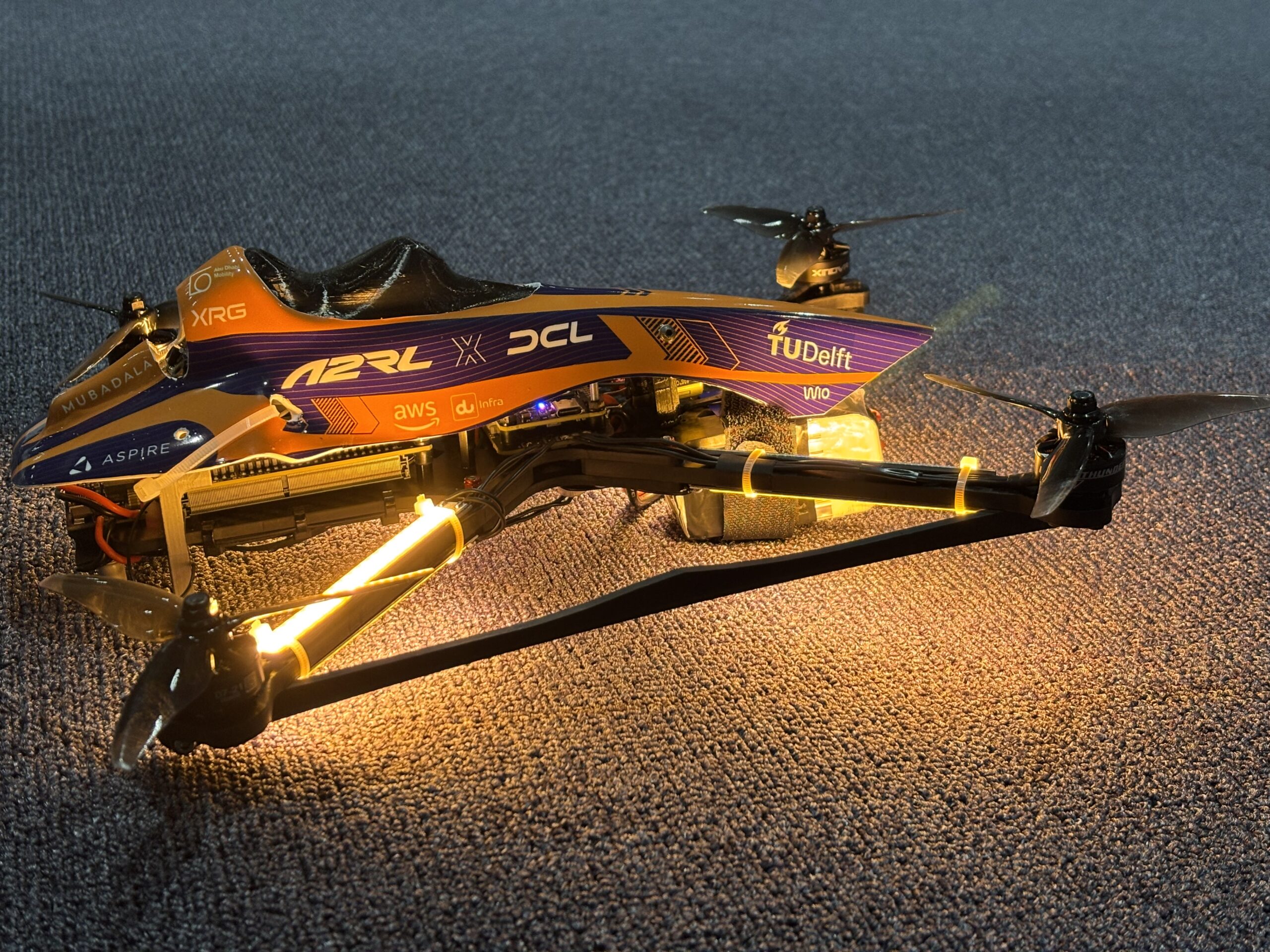
A team of scientists and students from TU Delft has taken first place at the A2RL Drone Championship in Abu Dhabi – an international race that pushes the limits of physical artificial intelligence, challenging teams to fly fully autonomous drones using only a single camera. The TU Delft drone competed against 13 autonomous drones and even human drone racing champions, using innovative methods to train deep neural networks for high-performance control. The gained knowledge on highly-efficient robust AI will contribute to many robotics applications, from self-driving cars to humanoid robots.
Beating human pilots
For the first time, a drone has beaten human pilots in an international drone racing competition, marking a new milestone in the development of artificial intelligence. On Saturday, April 14, 2025, two drone racing events took place simultaneously: The Falcon Cup Finals for human pilots and the A2RL Drone Championship for AI-powered, autonomous drones. As a climax, the best AI drones also competed against the best human pilots. The AI drone developed by TU Delft first won the A2RL Grand Challenge. It then went on to win the knockout tournament against human pilots, beating three former DCL world champions and reaching flight speeds up to 95.8 km/h on the very winding track.
The team of scientists and students from TU Delft achieved this by developing a highly efficient and robust AI system, capable of split-second, high-performance control. Whereas earlier breakthroughs, like AI defeating world champions at chess or Go, have taken place in virtual settings, this achievement happened in the real world. Two years ago, the Robotics and Perception Group at the University of Zürich was the first to beat human drone racing champions with an autonomous drone. However, that impressive achievement occurred in a flight lab environment, where conditions, hardware, and the track were still controlled by the researchers – a very different situation from this world championship, where the hardware and track were fully designed and managed by the competition organisers.
Pushing the frontiers of physical AI
The goal of the 2025 A2RL Drone Championship in Abu Dhabi was to push the frontier of physical AI, by stimulating research on robotic AI under extreme time pressure and with very limited computational and sensory resources. The drone had access to just one forward-looking camera, a major difference from previous autonomous drone races. This is more similar to how human FPV pilots fly, and leads to additional perception challenges for the AI.
The AI that won against the three former DCL world champions was developed by a team of scientists and students from the MAVLab at TU Delft’s Faculty of Aerospace Engineering. Team lead Christophe De Wagter is both exhausted and exhilarated: “I always wondered when AI would be able to compete with human drone racing pilots in real competitions. I’m extremely proud of the team that we were able to make it happen already this year. I hope that this achievement and this type of competition in general forms a springboard for real-world robot applications.”
AI that directly commands the motors
One of the core new elements of the drone’s AI is the use of a deep neural network that doesn’t send control commands to a traditional human controller, but directly to the motors. These networks were originally developed by the Advanced Concepts Team at the European Space Agency (ESA) under the name of “Guidance and Control Nets”. Traditional, human-engineered algorithms for optimal control were computationally so expensive that they would never be able to run onboard resource-constrained systems such as drones or satellites. ESA found that deep neural networks were able to mimick the outcomes of traditional algorithms, while requiring orders of magnitude less processing time. As it was hard to test whether the networks would perform well on real hardware in space, a collaboration was formed with the MAVLab at TU Delft.
“We now train the deep neural networks with reinforcement learning, a form of learning by trial and error. ”, says Christophe De Wagter. “This allows the drone to more closely approach the physical limits of the system. To get there, though, we had to redesign not only the training procedure for the control, but also how we can learn about the drone’s dynamics from its own onboard sensory data.”
Optimising robotic applications
The highly efficient AI developed for robust perception and optimal control are not only vital to autonomous racing drones but will extend to other robots. Christophe De Wagter: “Robot AI is limited by the required computational and energy resources. Autonomous drone racing is an ideal test case for developing and demonstrating highly-efficient, robust AI. Flying drones faster will be important for many economic and societal applications, ranging from delivering blood samples and defibrillators in time to finding people in natural disaster scenarios. Moreover, we can use the developed methods to strive not for optimal time but for other criteria, such as optimal energy or safety. This will have an impact on many other applications, from vacuum robots to self-driving cars”.
The TU Delft team: Anton Lang, Quentin Missine, Aderik Verraest, Erin Lucassen, Till Blaha, Robin Ferede, Stavrow Bahnam, Christophe De Wagter and Guido de Croon.
Publications:
- https://www.tudelft.nl/en/2025/lr/autonomous-drone-from-tu-delft-defeats-human-champions-in-historic-racing-first – https://www.tudelft.nl/2025/lr/wereldprimeur-tu-delft-ai-drone-wint-van-menselijke-bestuurders-op-wk-drone-racen
- Previous work on racing: https://doi.org/10.55417/fr.2022042
- Control: https://doi.org/10.1109/ICRA57147.2024.10611665
- RL: https://arxiv.org/pdf/2504.21586
News:
- https://www.aetoswire.com/en/news/a2rl1642025en
- https://www.dronewatch.nl/2025/04/16/autonome-drone-tu-delft-verslaat-menselijke-dronepiloten-op-wk-droneracen/
- https://www.businesswire.com/news/home/20250416147445/en/Artificial-Intelligence-Triumphs-in-Worlds-Most-Sophisticated-Autonomous-Drone-Race-in-Abu-Dhabi